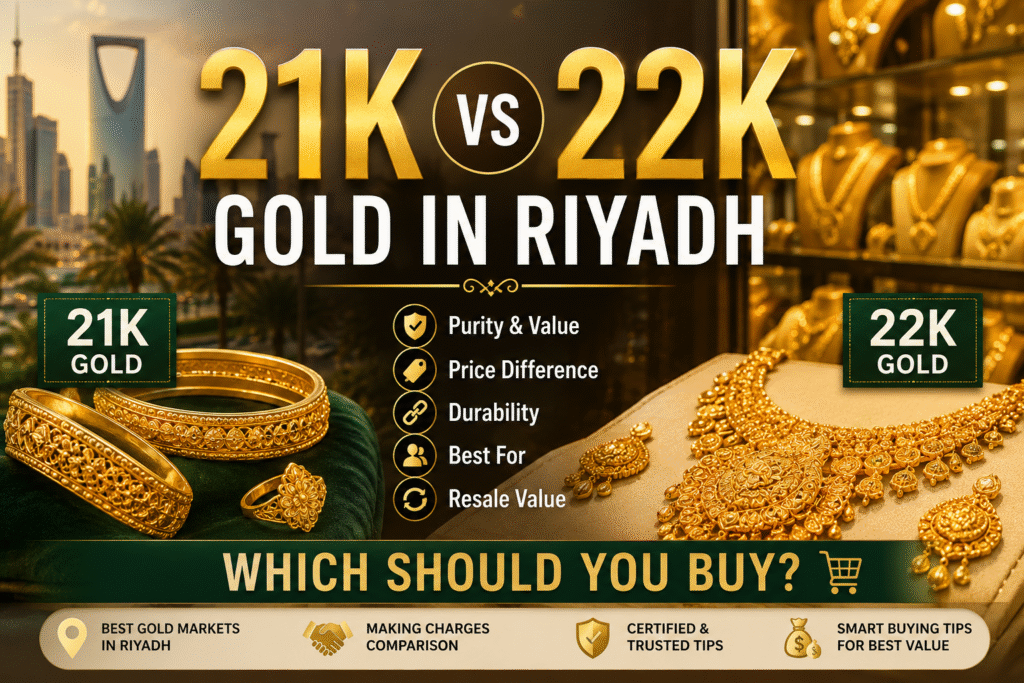
If you have spent any time browsing gold shops in Riyadh — whether at Al-Batha souk or a mall retailer — you will have noticed that 21K and 22K pieces often sit right next to each other, looking almost identical. The price difference per gram is there, but it is not enormous. So which one should you actually buy?
The answer depends entirely on what you are buying gold for. Daily wear, a wedding gift, long-term investment, and resale all point toward different choices. This guide breaks it down clearly so you can walk into any Riyadh shop knowing exactly what you want and why.
The Basic Difference — Purity and What It Means
Both 21K and 22K are gold alloys — meaning they are not pure gold, but gold mixed with other metals like copper, silver, or zinc to increase hardness.
| 21K Gold | 22K Gold | |
|---|---|---|
| Pure gold content | 87.5% | 91.67% |
| Alloy content | 12.5% | 8.33% |
| Hallmark stamp | 875 | 916 |
| Color | Warm yellow | Richer, deeper yellow |
| Hardness | More durable | Slightly softer |
That 4.17% difference in pure gold content is what separates them. It sounds small on paper, but it compounds meaningfully when you are buying a 20 or 30-gram piece — both in price and in how the piece behaves over time.
Price Difference in Riyadh — What You Actually Pay More
At today’s market rates (May 2026), the approximate difference per gram in Riyadh is:
| Karat | Approx. Rate (SAR/gram) |
|---|---|
| 24K | ~570 |
| 22K | ~522 |
| 21K | ~499 |
| 18K | ~428 |
So 22K runs roughly SAR 23 more per gram than 21K at current rates.
On a 15-gram necklace, that is approximately SAR 345 more for 22K before making charges and VAT. On a 30-gram bridal set, the gap widens to around SAR 690 in gold value alone — before the 15% VAT is applied on top.
For the live rate difference today, check the Riyadh gold price page — the gap moves daily with spot prices.
Which Karat Is More Popular in Riyadh?
Walk through Al-Batha or Al-Thumairi on any given day and you will notice that 21K dominates the everyday jewelry section — rings, bangles, daily-wear chains, earrings. It has been the workhorse karat for South Asian and Arab buyers in Saudi Arabia for decades.
22K tends to appear in heavier, more premium pieces — elaborate necklaces, high-value bridal sets, and items where the gold color depth matters aesthetically. Gulf-style bridal jewelry, in particular, traditionally favors 22K for its richer appearance.
Mall retailers stock both, but their display cases often feature 18K more prominently in modern designs — a different conversation entirely.
For Daily Wear — 21K Wins
If the piece will be worn regularly — a ring you never take off, a chain worn daily, a bangle that goes everywhere with you — 21K is the more practical choice.
Here is why: the additional 12.5% alloy in 21K makes it meaningfully harder than 22K. Gold in its purer forms scratches, bends, and deforms more easily under everyday friction. A 22K ring worn daily will show wear faster than the same design in 21K.
This is not a theoretical concern. In Riyadh’s traditional souks, the shop owners themselves will often suggest 21K for pieces intended for daily use, particularly for men’s rings and children’s jewelry, without even being asked.
The color difference between 21K and 22K is subtle to most eyes in person — both read as rich yellow gold in normal lighting. The durability difference, over months of daily wear, is real.
For Bridal Jewelry — 22K Is the Market Standard
For bridal sets — the elaborate necklaces, bangles, and earring combinations that anchor Gulf and South Asian wedding jewelry — 22K is the default expectation in Riyadh’s market.
There are two reasons. First, bridal jewelry is not worn daily — it comes out for occasions, meaning the softness of 22K is rarely a practical problem. Second, the deeper color of 22K reads better under the lighting conditions of wedding photography and events. The visual difference that is subtle in a shop becomes more noticeable when a piece is photographed or worn under event lighting.
For families buying bridal gold with resale in mind, 22K also commands a slightly stronger resale rate — more on that below.
For Investment and Resale — 22K Has a Slight Edge
If part of your thinking is eventual resale — whether to a jeweler, a gold buyer, or back into the souk — 22K holds a mild advantage.
Gold buyers and jewelers assess resale value based on the weight and purity of what you bring in. A 22K piece returns more per gram than a 21K piece of identical weight because it contains more pure gold. On a large purchase, this difference accumulates.
That said, neither 21K nor 22K is an efficient investment vehicle compared to 24K bars or coins. Jewelry carries making charges and VAT on the way in, and those costs are not recovered on resale. If pure investment is your goal, 24K bullion is the straightforward answer — VAT-exempt, minimal premiums, and sold at close to spot price.
For buyers whose goal is a combination of wearing and eventually selling — the most common situation in Riyadh’s market — 22K is the more sensible choice over 21K.
For Gifts — Depends on the Recipient
Gold gifts in Riyadh are common for weddings, Eid, and newborns. Which karat makes sense depends on what the recipient will do with it.
For a gift intended to be worn regularly — children’s bracelets, everyday rings — 21K’s durability is a practical advantage. For a gift intended as a keepsake or for occasional wear — a gift to a new bride, an Eid gift for an adult — 22K’s higher gold content and color richness make it feel more premium.
When in doubt, 22K is the safer gift choice. It is harder to go wrong with higher purity on a piece given as a mark of occasion.
Side-by-Side Summary
| 21K | 22K | |
|---|---|---|
| Daily wear | ✅ Better | ⚠️ Softer |
| Bridal jewelry | ✅ Acceptable | ✅ Preferred |
| Investment / resale | ⚠️ Lower gold content | ✅ Slightly better |
| Price per gram | ✅ Lower | ⚠️ Higher |
| Color richness | ✅ Good | ✅ Richer |
| Hallmark | 875 | 916 |
| Availability in Riyadh souks | ✅ Very common | ✅ Very common |
How to Identify Each Karat at the Shop
Both karats carry mandatory hallmark stamps under Saudi standards. Look for:
21K: Stamped as 21K or 875 — usually on the inner band of rings, the clasp of necklaces, or the back of pendants.
22K: Stamped as 22K or 916 — same locations.
If a shop cannot show you the hallmark on a piece, or the stamp is missing, that is a significant red flag. All legitimate gold sold in Saudi Arabia carries SASO-mandated hallmarks. Do not purchase any piece that lacks one.
Current Prices — Check Before You Shop
Gold rates in Riyadh shift throughout the day with the international spot market. Before visiting any souk or mall, check today’s live 21K and 22K rates on the Riyadh gold price page — it gives you the exact SAR per gram figure to use when evaluating any quote you receive.
For broader Saudi Arabia price context and 7-day trend charts, the Saudi Arabia gold price page tracks the market daily.
The Short Answer
Buy 21K if the piece will be worn every day and durability matters more than maximum gold content.
Buy 22K if it is for a wedding, a significant gift, occasional wear, or if eventual resale value factors into your decision.
Neither choice is wrong — they are optimized for different purposes. The clearest mistake is buying the wrong karat for what you actually need, not choosing one over the other.
Gold prices referenced in this article are based on live international bullion spot rates converted at the fixed SAR/USD peg of 3.75. Check the Riyadh gold price page for today’s exact per-gram rates before any purchase.